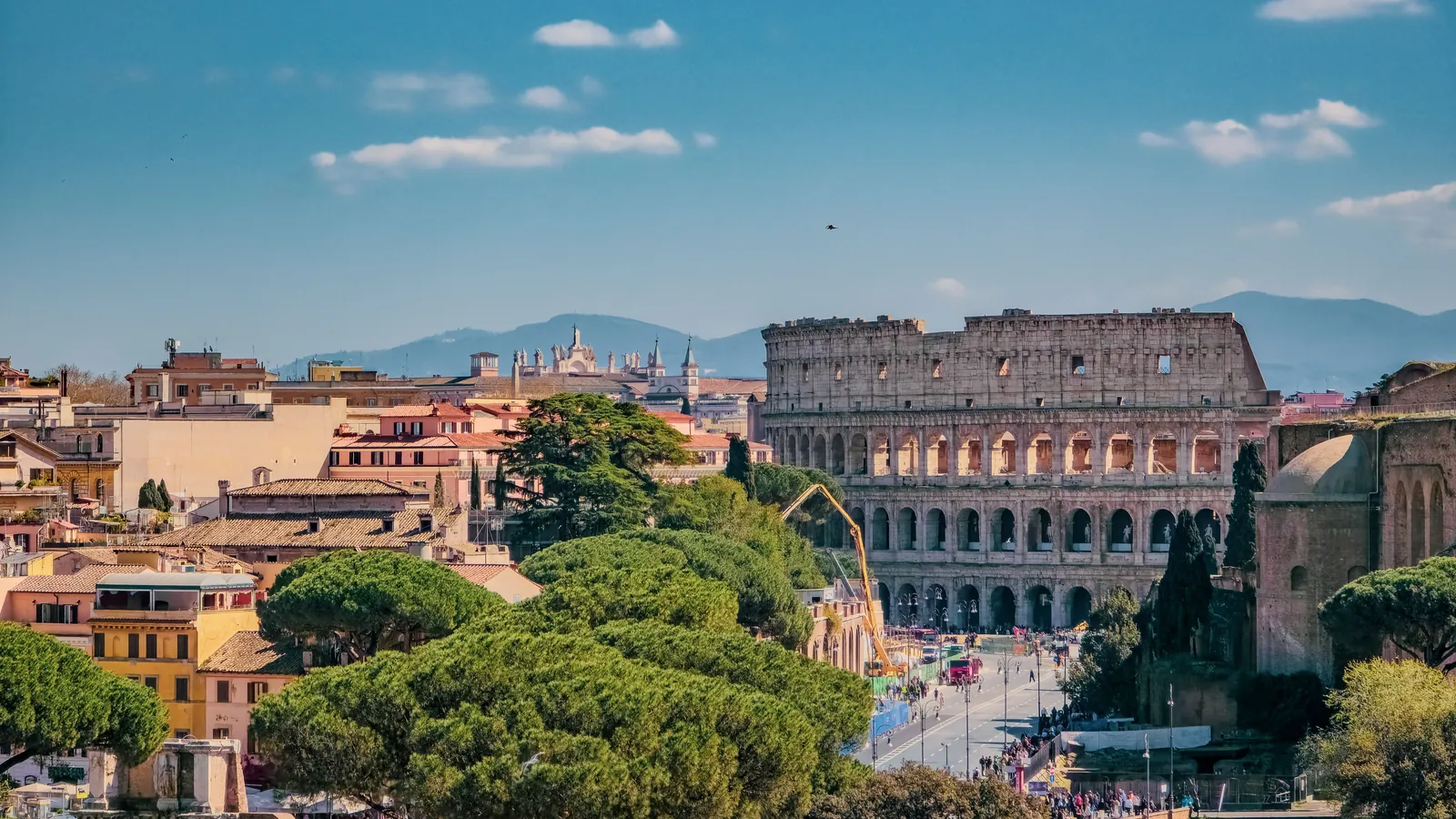
Short trip
Big Bus 3-hour pass
A shorter taster of the Red Loop — 3 hours of hop-on hop-off, ideal if you only have a half-day in Rome.
—
See ticket

Plan your perfect day in Rome — and book your hop-on hop-off bus ticket here. We compare live prices from all four bus operators and three trusted resellers, so you always get the best deal. Your ticket is delivered to your phone within seconds.



Shorter trips, single-loop tickets and day passes — useful if you don't need a full 24-hour ticket.
A shorter taster of the Red Loop — 3 hours of hop-on hop-off, ideal if you only have a half-day in Rome.
One full ride around the Yellow Line without hopping off. Cheapest option if you just want the panorama tour.
Valid until end of your booking day, not 24 hours from activation — cheaper than the 24h ticket if you start early.
Bundle the hop-on bus with the most-booked attraction tickets and save vs. buying separately. Live prices from our partner sellers.
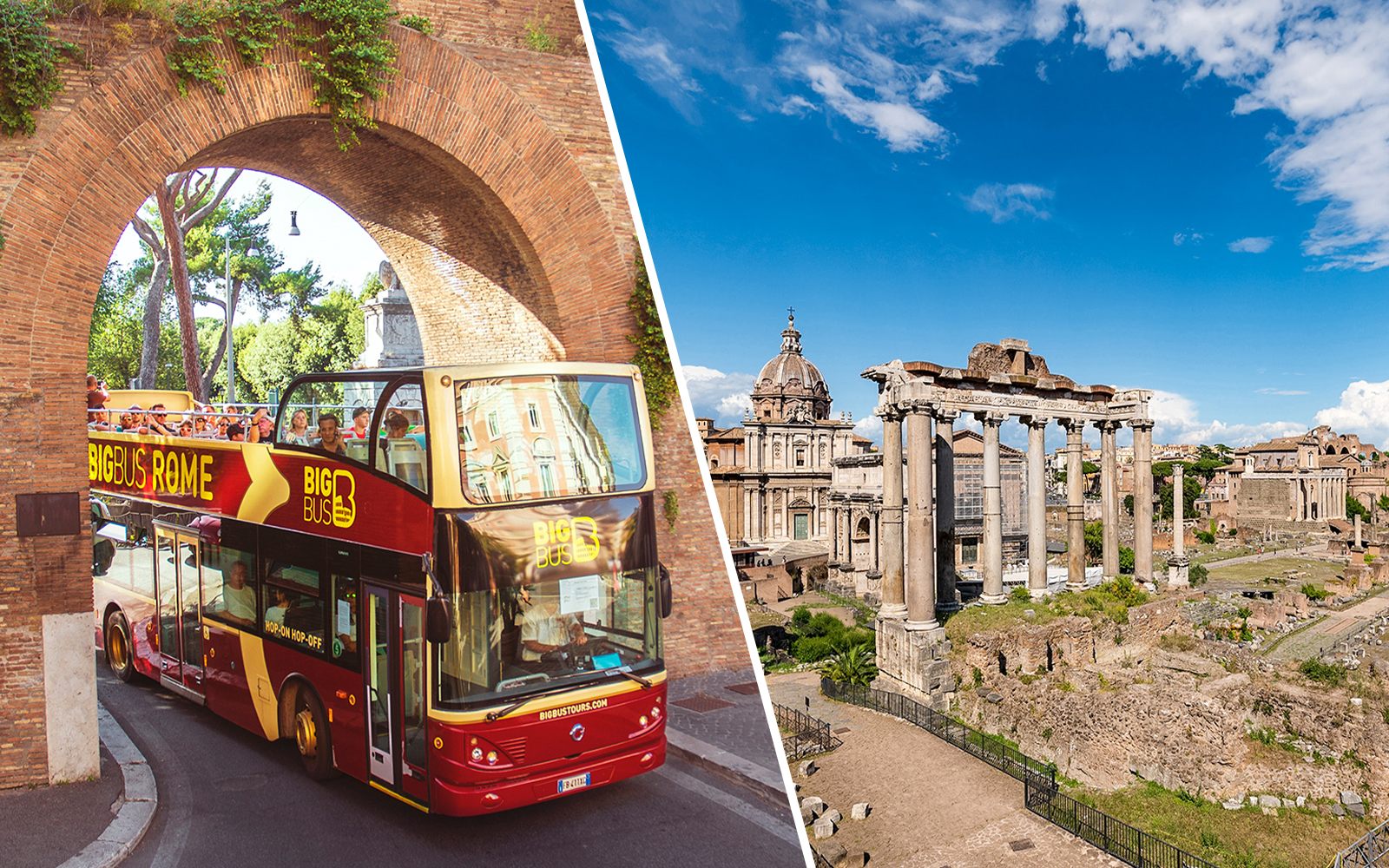
Timed entry to the Colosseum, Roman Forum and Palatine Hill bundled with a 24h hop-on bus pass. Headout's top combo for Rome.
View ticket
Vatican Museums + Sistine Chapel skip-the-line entry plus 48 hours of hop-on hop-off bus access across Rome.
View ticket
Skip the queue at St. Peter's Basilica with a 90-minute guided tour, plus 24h on the hop-on hop-off bus. One of Headout's top-selling Rome combos.
View ticketRome has four official sightseeing-bus operators. They differ in routes, number of stops and audio guide languages. Pick the one that matches your day.
1 red route · 8 stops · top-rated brand
The international Big Bus brand runs one red loop with 8 stops, departures every 9 minutes, and an 8-language recorded audio guide. The Discover/Essential/Explore tickets bundle the ride with a digital Vox City walking tour, gelato or prosecco, and free date changes.
2 lines · 14 unique stops · integrated Omnia network
City Sightseeing runs two interlocking lines (Red + Yellow) on one ticket — 14 unique stops covering the icons plus wider stops like San Giovanni in Laterano, Largo Argentina and Villa Borghese. The two lines share 6 stops, giving 20 boarding positions in total. Integrated with the Omnia + Roma Cristiana network. As of mid-2026 three stops are temporarily suspended due to roadworks — check the operator app before you board.
I Love Rome · 1 route · 12 audio languages
Gray Line's pink "I Love Rome" buses run one Essential Rome loop with 8 stops, departures every 10–20 minutes and a 12-language audio guide plus a kids version (EN/IT). Tickets cover 24h or 48h — Gray Line does not sell a 72h option directly, but resellers list a 72h variant.
3 routes · 15 stops · 16 audio languages
Green Line Tours has the widest network: 3 routes (Green/Orange/Blue) with 15 stops total covering the city centre plus off-the-beaten-path locations (Pyramid, MAXXI, Auditorium, Bioparco). One ticket covers all three lines, with audio guide in 16 languages.
All four operators share the same 8 core stops along an almost identical central loop. City Sightseeing extends this with a second Yellow Line that adds 6 extra unique stops (San Giovanni in Laterano, Largo Argentina, Piazza Navona, Villa Borghese, Piazza di Spagna and Piazza Barberini), and Green Line adds two further routes that cover Rome's modern art quarter, the Pyramid and the southern districts. Below is the universal main loop — click any stop to see what's within walking distance.
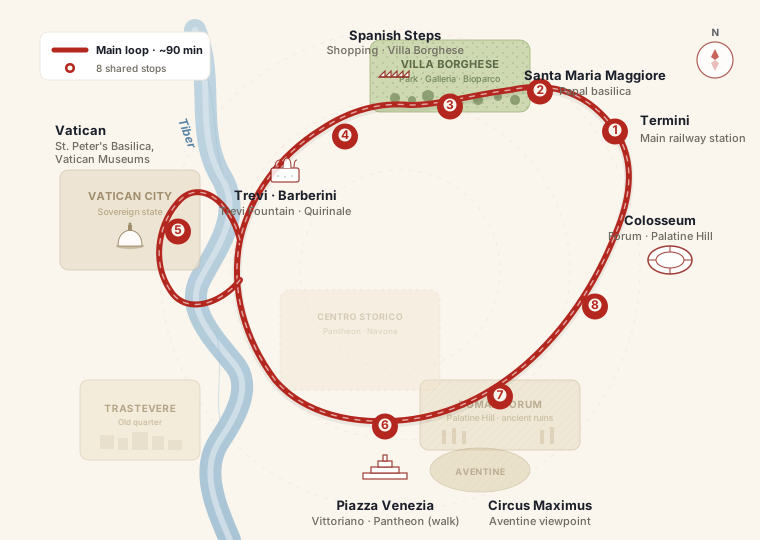
Most hop-on buses start and end their loop here. Termini is also Rome's biggest metro and airport-bus hub — perfect entry point if you've just arrived from the airport.
One of the four major papal basilicas in Rome, with the oldest Christian mosaics in the city. Far less crowded than St. Peter's and entry is free.
The Spanish Steps are the most photographed staircase in Rome — climb to the top for the view, then dive into the luxury shopping streets of Via Condotti below.
Throw a coin in the Trevi Fountain to guarantee a return trip to Rome — it's an old tourist tradition, but it really does make for one of those moments you'll remember.
The world's smallest country and the spiritual heart of Catholicism. St. Peter's Basilica is free to visit; the Vatican Museums need timed-entry tickets booked well ahead.
The geographic centre of Rome. From here it's a short walk to the Pantheon, Piazza Navona, the Capitoline Museums, the Roman Forum and Trajan's Forum.
Today an enormous grass oval, in antiquity Rome's biggest chariot-racing stadium with 150,000 seats. Walk up Aventine Hill for one of the best free viewpoints over the city.
Built between 70 and 80 AD, the Colosseum is Rome's most-photographed monument. Buy your entry ticket online before you go — the queue at the entrance can swallow 90 minutes of your day.
Green Line is the only operator with a three-route network. On top of the main loop above, two extra branches take you to the Pyramid of Cestius and the Testaccio food quarter (Orange Route, south), and to the Auditorium Parco della Musica, the MAXXI contemporary art museum, the Etruscan Museum, Bioparco zoo and Galleria Borghese (Blue Route, north). Best pick if you want to see more than the standard postcard Rome.
All four operators run year-round, but timings differ. Here's when buses run, how often they come, and a few things first-timers wish they'd known.
| Operator | Hours (high season) | Frequency | Lap time | Audio guide |
|---|---|---|---|---|
|
Big Bus
|
09:00 — 20:18 | Every 9 min | ~103 min | 8 languages |
|
City Sightseeing
|
09:00 — 18:30 | Every 10–20 min | ~100 min | 8 languages |
|
I Love Rome
|
08:30 — 20:30 | Every 10–20 min | ~105 min | 12 languages + kids |
|
Green Line
|
Daily service | Varies per route | ~3h network | 16 languages |
In low season (November to March) most operators reduce hours by 30–90 minutes and frequency drops by about a third. Tickets cost the same — but a 24h pass on a short winter day gives you fewer effective hours, so consider the 48h option if you're visiting between November and March.
For 24h, 48h and 72h tickets the clock begins on first activation, which means you can book today for use tomorrow with no rush.
Standard counter-clockwise loop: Vatican → Spanish Steps → Trevi → Piazza Venezia → Colosseum. Hitting the Vatican first means you beat the worst Museum queue, then ride into the centre as it warms up.
In July and August the open-top deck under the Roman sun gets brutal. There's shade on the lower deck. In November to March, an extra layer makes the morning ride a lot more pleasant.
Both Big Bus Tours and Green Line have free apps with live bus positions. Waiting at a stop without knowing if the next bus comes in 2 or 20 minutes is the single most-cited annoyance in reviews — the app solves it.
You don't have to take a sightseeing bus to see Rome — here's a quick honest comparison of your options.
Rome's metro is fast and cheap (€1.50 per ride, €7 for a 24h pass) but only covers two lines. The closest Vatican stop (Ottaviano) is a 10-minute walk from St. Peter's, and neither line stops at Piazza Navona or the Pantheon. Trastevere has no metro stop at all — you'll need a tram or bus. City buses fill the gaps but require some local knowledge. Best choice if you're a confident traveller, on a tight budget, and don't mind walking the last 5–10 minutes to each landmark.
Rome's historic centre — Pantheon, Piazza Navona, Trevi, Spanish Steps — is genuinely walkable in a single afternoon. What kills walking-only days is the distance from the centre to the Vatican (35 min walk one way) and from the centre to the Colosseum (20 min). Add Rome's seven hills and a typical summer day of 32°C, and your second-day energy collapses fast. Walking is perfect for the centre. The bus is the smart hack for the bigger Vatican-to-Colosseum spans.
The bus connects the four major areas (Vatican, Spanish Steps, Piazza Venezia, Colosseum) with audio commentary in your language and lets you skip the public-transport puzzle. You get a city overview on day 1 and a flexible base on day 2 to dive deeper. For 24 hours of unlimited rides on a 90-minute loop, it works out to ~€1.20 per ride — cheaper than a taxi, faster than walking, comfier than the metro.
Pick the bus if you have one or two days in Rome, want to see the iconic four areas without thinking too hard, and don't want to commit to one location. Pick the metro + walking combo if you have four days or more, you're staying central, and you enjoy the navigation puzzle. Pick walking only if you're staying inside the historic centre and skipping the Vatican.
Hop-on hop-off buses are one of the easiest ways to do Rome with children — no walking marathons, no metro stairs with a stroller, and you can break up the day with stops for ice cream. Here is what you need to know about child tickets and family-friendly stops.
| Operator | Child age | Free under | Adult from |
|---|---|---|---|
| Big Bus | 5–15 | < 5 | 16+ |
| City Sightseeing | 5–15 | < 5 | 16+ |
| I Love Rome | 6–11 | < 6 | 12+ |
| Green Line | 6–12 | < 6 | 13+ |
Above the child age limit, an adult ticket is required. Under the minimum age, kids ride free as long as they don't need their own seat.
Folded strollers are accepted on all four operators. The open-top double-deckers have luggage space on the lower deck — keep the stroller there and head upstairs for the views. Big strollers in peak season (July/August midday) can be tight.
The most rewarding stops with kids are Piazza Venezia (gelato + Wedding Cake monument), Circus Maximus (open space to run), and Castel Sant'Angelo (a real castle with bridges and angels). The Colosseum stop has the wow factor but bring patience for the crowds.
Gray Line / I Love Rome offers a dedicated kids audio channel in English and Italian — explanations are shorter and aimed at younger ears. The other operators have a single adult-focused commentary; older kids (10+) usually follow along fine.
Rome midday heat in summer (July–August) hits hard, especially on the open top deck. Start early (first bus around 09:00), take a long midday break, and return after 16:00. The 48h or 72h ticket pays off here — you don't need to cram everything into one exhausting day.
More questions about family tickets, infants and discounts? See our FAQ section.
Rome is a year-round destination, but the hop-on bus experience changes a lot with the weather. Here's how the four seasons compare for an open-top sightseeing day.
The best window. Mild weather, full schedules, blooming parks. Easter week is the only spike; either side of it is golden.
Toughest season. Open top deck is brutal after 11:00. Start at 09:00, ride the top early, switch to shaded lower deck or museums by midday.
Equal best with spring. Long service hours still apply through October. First week of October is the sweet spot of the entire year.
Iconic sights almost to yourself. Service hours and frequency drop by ~30%. Tip: a 48h pass is better value than 24h on a short winter day.
If you can pick your dates, second week of May or first week of October hit the perfect intersection: mild weather, long service hours, and the Eternal City looking like the postcard you came to see.
Live prices from Tiqets, GetYourGuide and Headout in one place. One click takes you to the cheapest current offer — no booking fees, no markups, no detours.